
Strictly speaking these pieces are not formal critical reviews of the chosen books, but really comprise observations and commentaries on the texts. They reflect how strong an impression the books made on me.

Please note: the pieces on novels by Ali Smith and Jack London summarise the whole plot of each book, so best avoid those if you haven’t yet read the books (but I recommend that you do!).
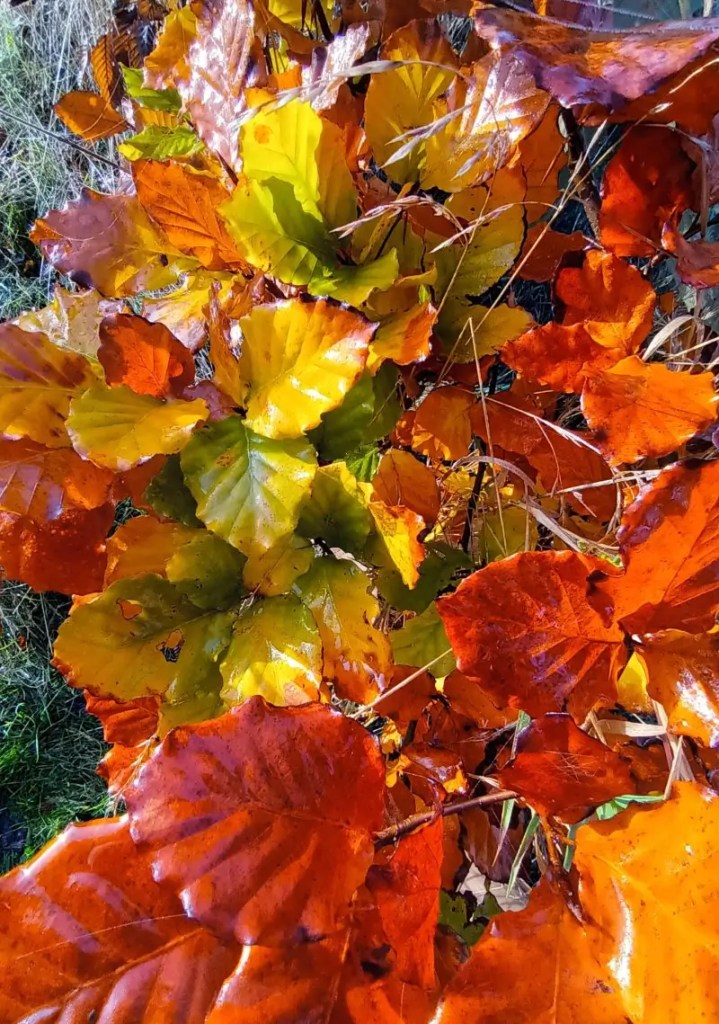
Autumn – Ali Smith
Ali Smith’s “Autumn” is an inauspicious season. Amidst the aftermath and micro-aggressions of the Brexit vote, Elisabeth pays weekly visits to a care home to read to Daniel as he sleeps. He is her neighbour from childhood, 70 years her senior, and their friendship forms the still centre to this novel of contained fury, allegory, and tenderness.
They meet first when she is eight and growing up in a London suburb with her mother, in the 1980s. Daniel is thought ‘foreign’ (his nationality implied as French), but Elizabeth is instinctively independent-minded and welcomes his conversations on art, and stories, and stories about art, and how to ‘read’ people. He offers a humane education which fascinates her against the background of the protective conservatism of her mother. Their friendship persists through Elisabeth’s adolescence then drifts as she leaves university, until in her thirties she is drawn to hold vigil at his bedside as he reaches the last days of his long life, her devotion borne of intense connection, and guilt. She tells him as he sleeps: “But I want to apologise for not being here these last years… I was hopelessly hurt, about something stupid… Myself, I thought about you for the whole time. Even when I wasn’t thinking about you, I thought about you”.
But this simple story is not told simply. Opening an Ali Smith novel, one enters a world shown askance, where the text conjures a sway of images, sensations and proclamations. In “Autumn”, Daniel’s and Elisabeth’s separate and shared memories are beautifully spun as fragments of perception, conversation and fantastical dreams – past, future, reality and dreamworld flow in a layering intricate and seemingly imperfect. We see vignettes of Daniel’s boyhood, schooled in Britain as a young man at the outbreak of war while his brilliant younger sister remained, but did not survive, in France. We find suggestions of his later life as an émigré, a songwriter moving in fashionable Sixties’ circles of musicians and artists, his responses inspired, but always grounded too, by art and poetry. There is also a binding connection between Daniel and Elisabeth in the vital form of the feminist artist Pauline Boty, whose vision stirs devotion in Daniel and whose work and brief, bravura life becomes the muse for Elisabeth’s studies. But Boty’s fearless defence of the feminine and feminist in art also, in Smith’s hands, flowers into an excoriation of the dead-hand of the establishment. Boty responds to the Profumo affair by painting Christine Keeler, attempting to rescue her from press depictions engineered to defame her, as a ‘bad’ girl made good.
Now as then, political deceptions hold sway, but in 2016 the lies of the powerful have served to reprise divisions which echo those fostered at the start of war in Europe – the Europe of Daniel’s youth: “Elisabeth passes a cottage not far from the bus stop whose front… has been painted over with black paint and the words GO and HOME”. Elisabeth encounters too, as she applies for a passport, the glories of an obdurate officialdom, which seems to reflect a more sinister mood emanating from Brexit, an implication that you don’t belong if you can’t prove you’re from ‘here’. And Smith gives full flow to this mood in prose as blunt as the rupture it describes, an incessant litany of dissonance: “All across the country, there was misery and rejoicing… All across the country, people felt legitimized. All across the country, people felt bereaved and shocked… All across the country, people waved flags in the rain. All across the country, people drew swastika graffiti. All across the country, people told people to leave.”
But stowed among the hurt are small acts of kindness and visions of beauty – Daniels’s instinctive comfort for Elisabeth when a child, as she cries for lost memories of her father; and the stillness of Daniel in repose “…his sleeping head noble… his eyebrows mere moments of frost”, as Elisabeth reads and watches his closed eyes. There is also always the integral vein of the natural world coursing quietly beneath human affairs, of nature steadfastly playing out its own rhythms. It gets on with being bountiful and, if we let it, it can absorb our mistakes and stupidity, even as we borrow from it for our metaphors and purloin it for our physical needs. In tribute to her autumn setting Smith creates dream-scenes of strange intimacy between trees and people, where humans draw strength from the living wood and we are clothed benignly by their leaves.
Smith is a master of depiction, and she makes her word drawings with a poet’s precision and a play of language that can fill our minds both with unease and with beauty. But she is also a master of narrative, deceptively so as the story-telling patterns are loose and there is often a discomforting sense that nothing is completely known. Ideas and motifs recur and form pinpricks of light and these, at times, harmonise and coalesce. And the brightest light in “Autumn” is that which comes from human connection: “We have to hope, Daniel was saying, that the people who love us and who know us a little bit will in the end have seen us truly. In the end, not much else matters”.

Winter – Ali Smith
“Winter” is a book about coping with the chill of what we feel when faced with the damage done to people through injustice, and the damage done by people, to the world. There are four people at the heart of this story, and two find the chill settling in their bones, crumbling their perceptions and relationships.
Sophia, retired from a life of self-sufficient and successful business and living alone in her over-large Cornish house, finds her vision, and ultimately her daily life, playing host to the silent, disembodied, but apparently living and benign, head of a child. She initially registers this as novelty rather than hallucination, but the weight of its presence and likely meaning stir a buried consciousness of worldly sufferings : “Sophia had been feeling nothing for some time now. Refugees at sea. Children in ambulances. Atrocities… Nothing… But now… she felt pain play through her like a fine-tuned many-stringed instrument”. Christmas Eve finds her seated in her kitchen wrapped tight in winter clothes even though the room is heated to roasting, in a house with all doors flung open and empty of food and decoration. Sophia’s son, Art, is similarly at sea, but adrift in the messy end of a relationship, unable to engage with the activism and sensitivities of his girlfriend, Charlotte, though he fashions and displays his own heightened sensitivities through his nature-writing blog. He begins to believe Charlotte’s picture of him as a narcissistic, selfish fraud, naively ignoring the flaying of the natural world and the politics that allows it.
Without a girlfriend, a laptop (defenestrated by Charlotte) or self-regard, Art prepares to visit Sophia for Christmas and, inspired to mask the first of those losses at least and save face with his mother, he arrives in Cornwall with a new girl called Lux, who he met at a bus stop in London and who has agreed to his plea for her to act as a substitute Charlotte for which, after Christmas, he’ll pay her £1,000. To Art, Lux appears to be “a girl like a broken bird”; she is a waif of London, in frayed but clean clothes, replete with face piercings, and “her wrists have the thinness of the child she isn’t far from having just been”. Her English is accented European, yet she is confidently and playfully spoken, and as they arrive at Sophia’s house and register her mental crisis, Art flounders and Lux makes a decision which he cannot conceive his mother would approve of: to summon Sophia’s older sister Iris to stay.
Iris and Sophia have been estranged for 30 years for reasons which mirror Art and Charlotte’s fracture – Iris’s compulsive social activism, which forged a life of rebellion lived in communes and at Greenham Common, where protests brought criminal records and in turn brought the surveillance state to bear on Sophia’s ordered, responsible reality as entrepreneur and working mother. To Sophia, Iris is the “mythologiser”, making up and taking up worldly traumas to revolt against, selfishly following her anarchic impulses and bringing shame to her family. But it is Iris who, against Sophia’s antipathy and rawness, girds her maternal and humorous heart and presents a Christmas meal for all. Gathered at the table, Iris, Sophia and Lux impart their creeds, while Art senses his failing connection with others and longs for “the essentiality of winter… to freeze, to shatter, to unmelt himself”.
It is in this scene that the essence of Ali Smith’s creed is unfurled too. A story of personal splintering becomes a testament to the salve of the ‘ties that bind’: family, and the care of the stranger. Together, Iris (unconsciously) and Lux (consciously) draw Sophia away from her entrapment in graphic but level-headed fear of the world’s cruelties. Iris will always challenge Sophia’s conservatism but their memories of a shared childhood soften adult scars. And in Lux, though she is the one apparently given succour from homelessness at Christmas, we find there is an astonishing wisdom, an instinct for understanding distress and assuaging it by word and action.
There is inevitable darkness in this tale, of minds flinching from the knowledge of others’ pains, but we find that hope is a gift that can come unbidden, from the insight of others. And the shadows and brightness in the story are reflected in Smith’s customary eliptical writing. Reading her is almost other-worldly and certainly non-linear; you can’t be sure where you’ll be taken next. Dialogue and declamation run parallel and dreams paint fantastical pictures; her narrative voices are very intense and immersive – the visceral oozes through the domesticity, and the sheer density of the imagery is almost crushing. But while supremely visual, this landscape of language is also whimsical and witty, and her writing of people thinking is exactly right: rooted in roaming connections, from memory to musings to sensations.
At heart, “Winter” is a commentary on our response, and responsibility, to the sickness – of our own making – of the planet and its people. Faced with this, we may find ourselves paralyzed or energised, and each response has its own compromises. Activism is anti-social, and especially difficult to live with for those who find taking serious responsibility for themselves demands all their energy. But Smith does not condemn those who feel, but can’t act; Sophia and Art are guilty of nothing but trying to cope with their own exposed emotions, as Sophia remembers Art’s childhood and that she had to “…work very hard – it is very, very hard – not to be hurt in the heart every time by every one of her son’s vulnerabilities”. What helps, in the end, is art, and the understanding of the outsider. It is Lux, as the émigré, who walks most easily through our culture and our inconsistencies (she is Croatian, but unable to bear her family’s wounds from that recent European war she came to London to study, finding her humane anchor here in Shakespeare). And it is Lux who perceives how our art reflects our social turmoil and, for many, can allay it. Sophia in fact knows this intuitively – “Beauty, his mother says… is the true way to change things for the better… There is no such thing as fake beauty. Which is why beauty is so powerful. Beauty assuages” – but she can only acknowledge it openly when Lux defends it. For Art too, Lux seems to be the prism through which sense and colour are restored. Lux after all, is Latin for light, for brightness. And, as Smith reminds us, even in the heart of the darkest days there is still the promise of light: “…even four days past the shortest day; the shift, the reversal, from increase of darkness to increase of light, revealed that a coming back of light was at the heart of midwinter equally as much as the waning of light”.

The Lost Soul – Olga Tokarczuk (words) & Joanna Concejo (pictures); translated by Antonia Lloyd-Jones. Seven Stories Press, 2021
“The Lost Soul” is a tale told in just over one page of words, and a gallery of thirty finely detailed, often whimsical, drawings. The textual story is short but deftly made, of a man (John) removed from his sense of self by ambition and work, to the extent that he forgets his own name. A sadly familiar crisis perhaps, but the verdict of his doctor is profoundly unusual: she tells him he is a man who has moved too fast for his soul, which has been left behind and is now lost from him, and the only remedy is to “find a place of your own, sit there quietly, and wait for your soul”.
From here, we are led in imagery through two strands of the story: John’s domesticity in the cottage he finds ‘on the edge of the city’ (his waiting place), and scenes and figures from the world beyond – in parks, cafes, housing estates, rural fairs. The locus of the latter scenes is ambiguous though. Are they John’s own memories from childhood, or views of the world that John has left, going its way without him as he waits? And waits.
The drawings depict John’s waiting, but they also function to reign in the pace of reading, to rest a gentle hand on our arm as we reach to turn the page, to encourage us to spend time with the story. And we must take this time, must linger and muse and explore as we face each image – because many are so equivocal in their context, but also because (we know and think) their details are so knitted to John’s past (and perhaps his future). These pictures form the narrative, but in a speculative, interpretive way. So as we rely on our gaze to unpick the image, this anchors us to John’s waiting – we too, must just allow matters to unfold, we must slow our consumption of the tale, wait for our minds to paint the unwritten history of John (a history which may materialise differently to each reader).
As we begin to understand John’s soul’s journey, it’s interesting to ask: could this story be told in words only? With pictures, we see the implication, without explanation, that the soul is as a child – not necessarily appearing as the child you were, but as the perception you had, perhaps the pure connection you found in response to another (so John’s soul is visualised as this other). For a writer, maybe such story elements could become obscured by descriptive metaphysics.
At the story’s close, we see colour returning to John’s world, and brief words tell us of a fairy-tale ending. Reading both text and image, we perhaps have arrived at a full narrative picture.
The Call of the Wild – Jack London (published 1903)
I – Synopsis
“The Call of the Wild” follows the evolving spirit of a dog of rare character as he travels on an enforced journey through the American north. This dog is Buck. Wily and powerful but magnanimous in nature, he belongs to a US state judge; he is a big cross-breed – a family dog, but free to roam at will over his master’s sunny Californian estate. In the fall of 1897 Buck is kidnapped by traders supplying sled dogs to prospectors heading to Canada’s gold-rush in the Yukon – the “frozen North”, vast in range, perilous and inhospitable in landscape and climate but, despite its fearsome bearing, irresistible to the thousands who come to seek their fortune.
Under the harsh regime of a ‘dog-breaker’ who wields a club to prime his obedience, Buck swiftly learns to curb his defiance and aggression against this new, captive existence. But the beatings do not instil fear in Buck, instead they unlock his cunning and self-reliance: in him, brutality breeds unwilling compliance, but not respect. Forced to live as a draft animal he quickly learns the lore of the dog pack where survival rests on vigilance to the hierarchy of the sled team. His authority in the pack is assured by arousal of deep instincts – social, predatory, and competitive – all employed when he savagely defeats his rival, Spitz, to take his place as lead dog. The North builds Buck’s body too, and his natural power knits with purpose: to be lead dog; to run, and keep on running.
Buck’s fortunes on the Yukon trail ebb and flow with a succession of sled drivers: a seasoned and harsh (but fair) Canadian duo; three novice travellers who over-burden and abuse the dogs; and his last owner, the miner John Thornton, who rescues Buck from these cruel masters and nurses his wounds, and so becomes the object of his fierce devotion. But Buck’s odyssey northwards becomes more than a physical journey: visions of his wolfish ancestors inhabit his dreams while distant howls haunt his days and impel him to roam the forest, killing prey as his instincts dictate.
The challenges of the North and his encounters with wolves in the woods release ancestral, vivifying urges in Buck, and his purpose and being are bound ever closer to a wild existence. When his bond with Thornton is broken by tragedy he runs with the timber wolves for good, his evolution complete – from companion animal to working dog, to free, feral creature. Of all the dogs brought to the North, it is only Buck who has been able to do this, by his inborn strength and his primal wits, which attune him to the Call of the Wild.
II- Commentary
“The Call of the Wild” explores how latent, primeval impulses are aroused in a tough, but thoroughly domesticated, dog, as he is confronted by harsh men and the harsh environment of the Northlands, in Canada’s 19th Century gold-rush. It is an audacious novel, as are all those other rare works of adult fiction which make an animal their chief protagonist. It is essentially the biography of a creature wrought around that creature’s own perceptions, and in any such work the challenge – one London effectively scales – is to avoid anthropomorphism while creating an ‘inner life’ for an animal that is convincing, rooted in what we know of animal motivation and behaviour (although of course, the true richness of animals’ perceptions are ever closed to us; such an account can only ever be a reflection of how we think they think).
While the novel is not directly narrated by its central canine character (Buck, a St Bernard / collie cross-breed), London’s approach is to inhabit the mind and life of his paragon of dogs and render how he experiences the world. London’s depictions of Buck’s instincts and reactions were no doubt informed by his own close observations of behaviour of sled-dogs on the gold-rush trails, and they ring true in their interrogation of the bond between mankind and dogs, which in cast can be both dark (brutality securing obedience) and light (care generating cooperation and devotion).
But in setting Buck on his journey into the wilderness, London’s mission seems to be greater than the ‘simple’ intent to describe animal intelligence and its reaction to an unforgiving environment. In “The Call of The Wild”, “the North” is mythologised as the proving ground for the survival instincts of both man and dog, and in Buck there is a thriving of the spirit as he confronts the privations and demands of hauling his body through the icy terrain and frozen forests. It is a release of ancestral strength, where mind and body are made keen through physical trials and returned to what they were fitted in prehistory to do: wilderness, London suggests, inevitably prises us from the soft shackles of civilisation, reunites us with our primal instincts and so make us truly human (or in Buck’s case, lupine). It is an idealised arc, and one few formerly civilised creatures, save Buck, might manage, and while he seems to be an archetype of canine vigour – the ‘uber-Husky’ – this idealisation by no means ignores the share of savagery that is part of his more elemental life (it is something of a mystery why “Call of the Wild” was ever regarded as children’s book).
“The Call of the Wild” is surely London’s response to the thrill he found in the far North, in the austere grandeur of the land. Perhaps he viewed his time there as some sort of invitation to the soul to get on with simply living, a task only truly to be met by physicality and instinct combined, with the whole of a man’s being focused on the work of survival. But perhaps he was also conscious that man – particularly civilised man – would always have to bring his devices and inventions to bear against the physical challenge of the North, and maybe this is why his character of choice for the novel was Buck. Only an animal, with no will to conquer the land and with only his bodily strengths and senses to call on, could hope to live there ably and freely, as kin to its native creatures.

White Fang – Jack London (published 1906)
I – Synopsis
Trekking through the frozen landscapes of the northern ‘Wild’ are two men and six dogs, pulling a sled which carries a coffin. Over the vast stillness of the snow breaks a far howl, and dogs and men know they are no longer simply weary travellers in the wilderness – they are pursued by wolves, and placed as prey.
The wolf pack is famished, and at their head is an unnerving, bold she-wolf who at night lures the sled dogs one by one into the forest and to the pack’s jaws. With only three rounds of ammunition the two men cannot scatter the wild hounds who haunt their campfire; Bill is lost trying to save the last dog, and Harry alone can only surround himself with a circle of fire to keep his tormentors at bay while he waits for the moment when sleep becomes irresistible, which he knows is the moment that will sanction their attack. Just as his eyes flicker and close, a posse of men and dogs arrive at last to save him from eager teeth.
As the chill hold of winter and its famine breaks, so the wolf pack fragments, and the she-wolf runs with One-eye, her victorious suitor, to settle in her lair and raise her litter of five cubs. Of these, there is but a sole survivor, a grey male cub: White Fang. The arc of his emerging animal consciousness – wary and curious, but fashioned to kill so he can eat and live – matures as he ventures from the comforting darkness of the lair into the light and ice of the land, to be tested by the Wild and the lives of predator and prey who also hunt and seek to survive there.
He and his mother inevitably encounter man – but particular men, who have a hold on the she-wolf, who is in fact a half-wolf, bred in an Indian camp but having since fled to her wild kin. She cannot resist the command of these men, and White Fang as a cub cannot forgo the company of his mother. They are taken by the tribe, and White Fang, through lessons of beatings and stonings, learns to accept man’s dominion. In his mother’s absence he is tormented and bullied by the lead dog in the tribe’s sled-pack, but hones his fighting impulses to defend his solitude and separateness – he may be remade into a sled-dog, but he is not of their pack. He is faithful to his master, Grey Beaver, in a bondage enforced through the threat of the club and the reward of food, although to the touch or command of other men he will not submit. While harsh, the terms of his allegiance to his ‘lord’ overcome even his will to return to the Wild: he howls in desolation to find the camp deserted as he returns from an escape to the forest, where he found his wild instincts so cauterised that only fear, not freedom, was found there.
At the Klondike, Grey Beaver is duped (through alcohol) into selling White Fang to Beauty Smith, a lover of cruelty and money, who cages him and trails him through the camps as the savage champion of dog-fights, the beast who would beat all-comers. When finally White Fang meets the only breed – the bulldog – that can counter his swift and fatal ferocity, and he is for once throttled by implacable jaws, one man at last comes who abhors the brutality of forced fighting and pays to free White Fang from his enslavement (having first struck down the wolf’s enslaver).
The saviour, Weedon Scott, and his sled driver despair at White Fang’s thrashing enmity to man, but both recognise a rare animal intelligence twisted by maltreatment, and Scott resolves to try to break the mantle of cruelty (itself borne of cruel oppression) laid over a creature whose nature is social rather than solitary, and predatory but not callous. By loosing his chains, by avoiding his eyes but engaging his ears by calm talk, and by offering food – not clubs or stones – in his hand, over many months the man disarms the fear and the rage in the wolf. His snarl descends to a low growl then to a mild, token vibration of his throat; he permits a hand to touch his ears and in time caress the deep fur of his neck; his eyes blaze not with fury and threat but with the light of devotion, ever following every movement of his new master, returning with quiet dignity the regard and respect he receives.
Scott’s travels leave White Fang under the good care of the sled-dog handler, but without the object of his allegiance he becomes bereft and sick. With Scott’s return, the wolf, his spirit fixed and fixated by this one man, releases the affection nurtured in him and buries his head under his master’s arm – more dog than wolf in that moment of reunion. Yet when the time comes for Scott to leave the north for good, he sadly resolves that a wolf – even his wolf – will not thrive or be accepted in his home state in the south. Confined to the cabin as Scott and his companion head to the dockside, for the second time in his life White Fang emits his primal howl, of abandonment and grief, “howling as dogs howl when their masters lie dead”. But the attachment cannot be broken; bloodied from bursting the cabin window, White Fang trails Scott to the quayside and slips quietly to his master’s side, and there he stays as together they sail south, his fidelity having dispelled Scott’s doubts and won his loyalty in return.
The teeming streets and the clamour of trams, cars and carriages confronts White Fang as they arrive in San Francisco, and at man’s mechanised “manifestation of power” he is awed again, as he was when a cub and first saw the Indians’ capacity to bend the material world to their will. But his new home with Scott is mercifully in the country, among farmland, woods and lawns, and in the family house of a great estate. Here he learns to recognise and respect his master’s kin and curb his instinct that farm animals are fair prey; his obedience in all these matters – even submitting to the affections of small children and enduring the ill humour of the family dogs – is born of protecting what he sees is of value to Scott. He also learns to play-fight in the spirit he’d been denied as a wolf-cub, though this sport he reserves for his master only: “he loved with a single heart, and refused to cheapen himself or his love”.
But a service and sacrifice for the whole family is made one night, as White Fang fells a criminal who enters the house intent on murder. The fight is won at the cost of three bullets in White Fang’s flesh, but even these wounds cannot overcome his constitution, born and steeled in the Wild. With this act he earns a new name: the Blessed Wolf.
II – Commentary
In “White Fang”, London seeks habitation in the mind and life of wild wolves, forging for us a vision of how their perceptions and senses process the world. He gives us a biography of a creature, mediated through its own animal instincts. But he does all this without anthropomorphising: he is at pains to ascribe no parallels between human and wolf responses to experience, events and environment. Recognisable ‘animal emotions’ we would know from our encounters with pets are there – affection, fear, joy in play – but London shows also the blood-motivation of the wolves’ predatory life, the ‘tooth-and-claw’ law of seeking to extinguish other forms of life to fund their own.
The writing is taut but elegant, grounded and precise, scoring out the patterns and elemental purpose of the lives of wild creatures, and their rootedness to the implacable land. Essentially, I think it’s a meditation on canine sensibility and dignity. It is also of course a blunt and icy commentary on the torment that man can mete out to animals, both wild and tame.

English Pastoral – James Rebanks
James Rebanks learnt from his grandfather the ‘old ways’ of working the land, just as those ways were on the cusp of being abandoned. And thirty years later he inherited his father’s farm just as farmers and farming were being slated as the villains of the English countryside – accused of denuding nature in pursuit of spiralling profit.
His book is a scything and emotional reflection on those two tipping points in the agricultural history of Britain, and at its centre is one key question: can the ecology and economy of our farming landscape be rebalanced? His answer is a three-part tale.
‘Nostalgia’ recounts his awakening to the pattern of farming traditions, as his grandfather cast a guiding arm round the awkward boy who couldn’t break through his father’s brusque and careworn bearing. His grandfather’s fields became his classroom, where he “walked and rode with him through the seasons”, listening to tales “full of horses”, watching from the tractor the plundering gulls following the plough, and wondering “whether the cows worked for my grandfather, or the other way round”. With his farm education complete, Rebanks realises he is a true believer in “that old farming world”, but at the same time he doubts that a Lakeland mixed farm like his can survive without leaving the old traditions behind. This doubt is laid bare in ‘Progress’. It is a clear-eyed – and painful – telling of the seductions of intensified agriculture, bearing intensely personal witness to the struggles of his own farming life. The modern economies of food production drove the Rebanks’ farm deeper into debt so, with initial resolve, the lifeline of new technologies is grasped – hedges are grubbed out, artificial feeds bought in, crops sprayed, flocks enlarged. But modernisation is itself costly. Rachel Carson’s Silent Spring is Rebanks’ epiphany, echoed in his father’s alarm that no gulls pursue the tractor as it ploughs his neighbour’s land (“there must be no worms in those fields”). Rebanks realises he had almost conditioned himself “to exclude nature from how we thought about the farm”, and he gives a damning account of how the cheap food ethic has driven that mentality, and what its consequences are: how dependency on fertilizers and pesticides has impoverished the soil, how habitats have been sacrificed to field size, and livestock – ‘engineered’ for rearing off the land, in factory units – have become ghosts of their hardy forebears.
In ‘Utopia’, there is a regathering of memories and mores as Rebanks seeks a settlement for his farming future on the land he now owns. He knows he “must work out how to make money from our land without wrecking it”, and his beacon on this quest is the personal history of the place bequeathed him, which resides in his grandfather’s care for his animals and the natural world of the farm, and his father’s honest labour and instinct for tradition. But Rebanks is both a romantic and a realist. The ‘old ways’ have value not simply as a show of heritage, but as a means of ensuring the cycle of production can continue: diverse meadows “run on sunlight” supply hay for native bred animals that are adapted to the fellsides, and their roughage-rich manure cast on the fields sustains the soil microbiome (and subsequent hay crop) in a way that ammonia-laden slurry from silage-fed cows will not. In turn, the nature that comes to fill the fields of the old valley farm sustains Rebanks himself, as the damage of past improvements is repaired and habitats are revived. Rebanks’ path is no easy step – the current economic model of food production does not reward good husbandry and he is resigned to working off the farm to top up the family’s income. But he is committed to maintaining his “beautiful compromise”, where “the hard work of breeding and selling stock recited on fields of grass” can at the same time restore a wild heart to farmed land.
“English Pastoral” is an intricate, seamless patchwork of farm journal and polemic, laying out the lure of modern farming’s treadmill and one family’s dilemmas on whether to tread that path. Ultimately Rebanks turns back to the farming values he was lucky to receive in his youth, seeing that the wisdom of ‘the old ways’ lies in respect for what the earth of a place can give, and what is required (love, labour) to nurture that earth so it can continue to give. In the last pages he movingly seeks to pass these values on to his young children, so they, if they wish, can spend their life “under the wing and the song” of the curlew, as he has done.

Green Tide – Richard Church (Country Life Ltd, 1945)
“Green Tide” is a slim volume, hardbacked and clad in rough, slightly care-worn sage green cloth, squareish and medium-sized and easy to handle. The paper is pale beige and shows vague crinkles at the margins, especially at front and back, but the print quality of the text and pictures is excellent – crisp and contrasty. This is important, for the illustrations are engravings by C.F. Tunnicliffe, and they were the chief cause of me buying the book. I glanced through the early pages and thought the content attractive too: gentle thoughts on nature and gardening, and further interesting as a mid-twentieth century example of the genre, published in 1945. Having since read the 26 chapters, in states of soberness, joy and wonder, I now realise the significance of that date, and how wrong I was about the tenor of the writing. The book’s paper quality clearly reflects the physical constraints of publishing in the 1940s (the Book Production War Economy Standard), while temperamentally the book is chiefly an act of witness to wartime in Britain. But it also so an enriching passage through the intellect and senses of the author, Richard Church.
His 26 essays are ordered as originally they appeared in Country Life (the renowned magazine of English rural affairs, established 1897), and though they are not dated, it’s evident that immediate pre- and post-war periods mark the start and end of their span, and their total number perhaps indicates they were published quarterly.
The first four tell of his settling in the Kent countryside, in an oast-house originally bought in early 1939 to allow occasional family escapes from London, but which becomes a fortuitous refuge from the blitz. Initially, the garden is the key concern in his writing: as a townsman with a love of earth and its fruits and a taste for labour, he is lyrical on the foibles of the Kentish soils, the characters of his fruit trees, and his own innocence in the art of harnessing nature’s impulses. But from the “Green Tide”, his first essay which entitles the book, there flows an unexpected shoal of shining scenes, stories and philosophies, almost all crafted from life as he finds it – from his boyhood, his days in cherished London, and his recent times in the ‘garden of England’.
All these essays are vignettes of an experience, often something as simple as walking a rural road or viewing the moon through mist, but sometimes as seminal (for him) as first reading Keats. His tales are intently and intensely told, and invariably reveal an abundant ‘imagination of the spirit’, and passionately held values which underlie, or emanate from, what he beholds. There is delight to be had in his description, but also in his exposition; both embody precision, but also unfold with a flourish of prose, an extra turn of a phrase – which is actually the stroke that makes a small masterpiece, rather than ruins it.
The book is also rich in the oppressive effects of war on the spirit, and it is salutary to realise one is reading a first-hand response to the ongoing years of combat – one cannot avoid the context of triumph or disaster in which he writes. And his place on the home-front is not wholly removed from the theatre of war: in 1940 crucial battles play out in the skies above Kent, the combatants come to grief on earth, and blackouts foreshadow the threat from above. This, and the ominous implication of it all, is the dark backdrop to daily life. But the pattern of his response, his experience, is that literary and natural beauty stab through the veil to offer hope (to his heart, at least). Occasionally this creates tension, as descriptions of his rural haven can seem at odds with the untold brutality endured on the battlefields of Europe and in the cities of England targeted by air.
But an essential truth rises from where he is placed: that the common ground of daily living, being so threatened, becomes transfigured. His common ground happens to be rural, and new to him, and that no doubt sharpens his senses doubly, and it fortifies him, allows him to behold history through the land around him, and to see and hold England as an exemplar of resistance to marshal overthrow. Perhaps consciousness of his readership at the time enlarged the force of this feeling, and his articles became a literary support for national morale. If that is so, Tunnicliffe’s illustrations are equal to this: they are incisive reflections of the text, grand in composition (even when depicting the domestic), and executed in a monochrome so vivid they are breath-taking.
“Green Tide” is now read, but I have not yet made enquiries as to who Richard Church was. Was he an established writer, or a professional in another sphere – a publisher, an academic, a lawyer? – with a writer’s bent? I have my own theory and am intrigued to know, but part of me wants to maintain the mystery, to listen to his voice without preconceptions borne of knowledge of his work and status. His depictions are entire and beautiful, sensitive and sensual, banked up by allusion and responsive emotion, conveying a scene felt. His voice is fluent and literary, his eye passionate, with a perception as intense, exacting and sharply wrought as Tunnicliffe’s images.
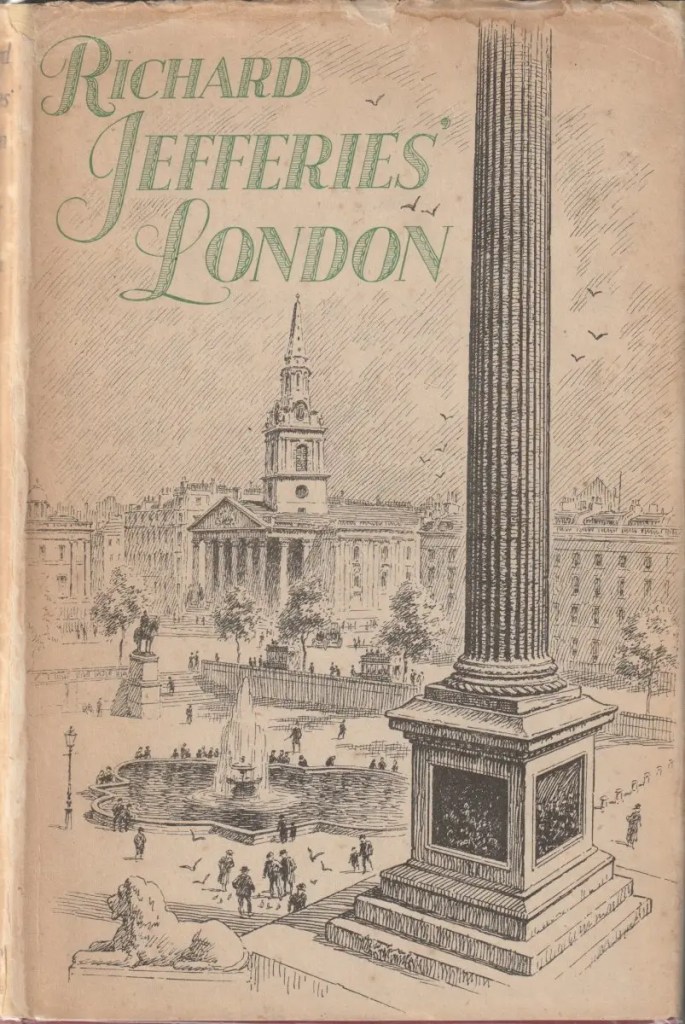
Richard Jefferies’ London – Samuel J Looker (ed). (Lutterworth Press, 1944)
Most of the essays and excerpts in this compilation were written when Richard Jefferies lived in Surbiton, Surrey, for several years from 1877, when the urban edge of Victorian London was still knitted among the fields, copses and villages of its surrounding counties. From his front door, Jefferies could walk among farmed land, find sheltered brooks and orchards, and there observe flowers, trees and birds in great abundance. The fine, exacting nature essays resulting from these encounters were first published in 1883 in ‘Nature Near London’, and many are reproduced here, affirming his reputation as a sensitive chronicler of the life of the English countryside. But his time at Surbiton, and his excursions into the city – his irresistible neighbour – released a further vivid, almost rapturous, element in his thoughts and prose, divined from what he viewed as the stirring mass of humanity at home within its great built estate.
This collection elegantly relates these two theatres of inspiration for him. And there is common ground in the unfolding of his expressions on both natural and urban themes – that is, Jefferies’ unrivalled precision of observation and his ability to render that in writing. He mentally absorbs the scenes before him and portrays their elements in language of simplicity and clarity, placing components precisely according to his view. In the natural milieu, this view often settled on the inconsequential fabric of the places he knew best – hedgebanks, verges, small scrubby pockets of fallow land. Here, his is a voice of locality, of the life of the forgotten tangled corners of the countryside, showing us how the clothing of foliage and flowers defines each season, or how the weather underscores, and birdlife enlivens, the moments he records.
He is meticulous in his depictions of these moments, but the artist’s eye habitually steps in alongside the naturalist, as he notes those times when a country scene becomes a picture in itself – when sunlight from a certain direction will flush across a landscape to create beauty. The orchard described in ‘The Toilers in the Field’ shows his pleasure in such fugitive places: “This little orchard, without a path through it, without a border, or a parterre, or a terrace, is a place to sit down and dream in… A stray passer-by would go on without even noticing it, it is so commonplace and unpretentious, merely a corner of a meadow irregularly dotted with apple-trees; a place that needs frequent glances and a dreamy mood to understand as the birds understand it… By day there is a loving streak of sunshine somewhere among the tree-trunks; by night a star above”.
From these essays, it is obvious that Jefferies’ heart and sensibility were anchored first to nature. Yet when in the orbit of London he felt the magnetism of the city straining at that anchor. This force pulled at his faculties as an instinctive observer, and his compulsion to attend flowed from the scale and grandeur of things to be seen there – of majestic buildings, of teeming crowds, of collective endeavour. His affinity was for the natural glories and repose of the country, yet he was not repulsed by the urban sprawl and the “life crowded and crushed together; life that hardly has room to live”. Indeed, his descriptive powers were applied as liberally to the commercial and architectural scenes of London life – the view from Waterloo Bridge, the forest of ship’s masts in the East End docks, the jumble of red tiled roofs at Bermondsey – as to the homely green spaces he revered. At the docks his keen eye notes of the ships at rest: “It is a great plain; a plain of enclosed waters, built in and restrained by the labour of man, and holding upon its surface fleet upon fleet, argosy upon argosy… masts across the river hung with drooping half-furled sails; masts afar down thin and attenuated, mere dark straight lines in the distance. They await in stillness the rising of the tide”.
This anthology lays open not only the duality of Jefferies’ inspirations, but also two strands in his response to the physical (natural and man-made) world: he is certainly a scrupulous recorder of the facts of what lies before him, but what he sees can provoke a mysticism in his writing too. There is a determined accuracy of natural history knowledge and precise visual analysis concerned with the colours, shapes and patterns encountered; but there are also moments of heightened consciousness when the images before him fire his intellect and feelings. It seems that Jefferies had a particular sensitivity to how light transfigures the commonplace, and in turn this transfigures his expression. He often tells of the beauty to be found when a place on earth is seen in all its particulars, as lit by elemental light, of sun or stars: “Except you see these colours, and light, and tones, except you see the blue heaven over the parapet, you cannot know, you cannot feel, how great are the possibilities of man”.
In his London city essays there is a sympathetic animation to his thoughts too, a wish to bring human hopes and fears under his gaze and tell of their place in the vibration of this paragon of cities. He shows London in all its power and motion and massing of man-made structures, and though, unlike the country, it does not offer to soothe his heart, it commands his – often affectionate – awe. It seems he felt as deeply for its welfare, and for the driven people of it streets, as he did for the countryside: “Is there any theory, philosophy, or creed, is there any system of culture… able to meet and satisfy each separate item of this agitated pool of human life?…there lives on in me an unquenchable belief, thought burning like the sun, that there is something to be found, something real, something to give each separate personality sunshine and flowers in their own existence now”. It is perhaps right to think, that if Jefferies could supply that ‘something’ to the people of London, it would be a connection with the blessings that he found in the natural world: “…the absolute quiet, peace, and rest which dwells in the meadows and trees and on the hilltops in the country”. Through his country writings, this is what he sought to do.

Finding WH Hudson – Mark Conor Jameson (2023, Pelagic Publishing)
In the 40 years spanning each side of the end of the 19th century, London was home to William Henry Hudson, writer and naturalist. The latter calling he held with great fervour, but he claimed little affection for the profession at which he excelled but through which he forged a national campaign for nature conservation, the impacts of which are felt to this day.
Hudson wrote vividly of his early years as a boy intoxicated by the birdlife of his Argentine homeland. Subsequent biographies examine his life principally as an author, but Mark Conor Jameson’s mission in his book is to bring colour and form to the years of Hudson’s greatest influence as a pioneer conservationist, when his innate passion for nature fired a literary output that touched great minds in politics and society, and swayed public policy on protection of the countryside and wild creatures.
Jameson achieves this in a very touching and absorbing text. He is meticulous in exploring contemporaneous articles, diaries and letters which show the fabric of Hudson’s daily life and the zeal he applied over decades to supporting the Victorian women founders of ‘The Bird Society’ (the fore-runner of the RSPB). He lays out intently and beautifully the context, influence and compromises of the life Hudson made in England, having sailed from Argentina in 1874, in his thirties. Hudson came here with the simple impulse to be in the land where renowned ornithologists worked and where he might find respect for his own dedication to wild birds.
But chance, the publishing industry and connections anchored him to London, and he railed at the habitual smogs, and the loss of wooded space and open land to unbarred urban sprawl. Movingly, Jameson tells how much-needed solace came from Hudson’s escapes among the landscapes of southern English counties – Berkshire, Hampshire, Sussex, Wiltshire, Cornwall – staying at the homes of devoted friends or in obscure country lodgings.
A key revelation for me from Jameson’s book is that Hudson’s life embodies the axiom that writing – books, articles, pamphlets, personal and public letters –was the genre of communication and campaigning in his age. And it is obvious that Hudson was at core a writer, with instinctive literary skill. He must have been conscious of this skill and knew he could enlist it to the cause of his heart, but it was perhaps an incidental occupation in his eyes, compared to treading the natural world and confirming his kinship with it. Jameson’s work makes clear, however, that writing always immersed Hudson, as evident from his output of 28 books in almost 40 years, plus substantial pamphlets opposing the plumage trade, several essays and seminal letters to The Times, and extensive personal letters to friends. His best known books (Birds of La Plata, Birds and Man, Birds in London, A Shepherd’s Life, the novel Green Mansions) and his lobbying works for The Bird Society reflect his fierce intent to forever speak of, and for, nature.
Jameson’s book is an accurate and sympathetic tribute to Hudson’s animistic spirit, which drove his will to protect what he loved through the honest expression of his writing. And the subtitle to “Finding W H Hudson” reflects this perfectly: “The Naturalist who came to England to save the birds”. Despite his final regrets at leaving the Pampas behind, one hopes Hudson realised that he was right to migrate and to live his later life in the place where his talent and passionate eye could have most purchase. It is certain that had he decided to stay in Argentina we’d not have the RSPB as we know it: his presence in England at that key time underpins much past and current action to save bird populations worldwide. And one hopes also that his writings are read anew as a result of this biography, and so continue to energise others in the cause of conservation.